
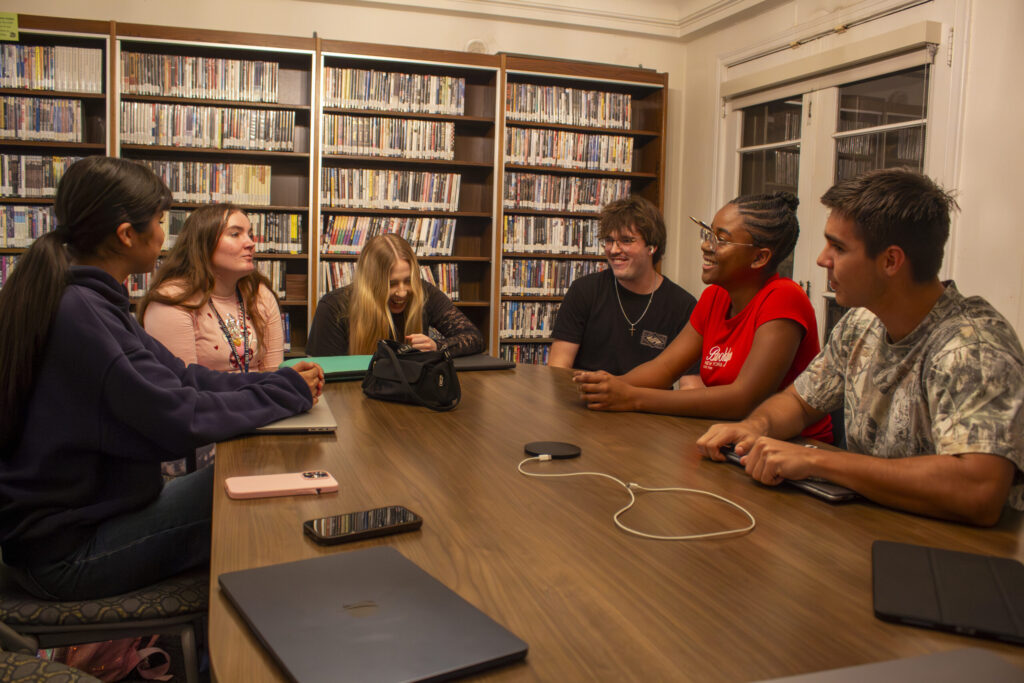
California Baptist University is a Christian institution, but it accepts students from various religious and cultural backgrounds, creating a diverse environment. That environment raises an important question: how do Christians at CBU interact with nonbelieving students?
Dr. Damon Horton, associate professor and director of intercultural studies, said he strives to create spaces where non-Christian students feel respected rather than pressured.
“I try to engage non-Christian students the way I see Jesus engage those who didn’t follow Him in Scripture, with dignity, compassion, curiosity, and honesty,” Horton said.
Kennedy Reynoso, senior English major, grew up in a strong Christian family and community. When topics such as the environment or perspectives on love arose, Reynoso said she experienced pushback from Christians around her.
“I grew up thinking that questioning God or questioning anything to do with Christianity was a sin,” Reynoso said, “so I got that internalized anxiety.”
After leaving home and joining the Coast Guard in New York, Reynoso met people who did not believe in God for the first time. She realized there were other belief systems in the world and began to “deconstruct” her faith. Eventually, she concluded that the version of Christianity she grew up with was different.
“[D]econstructing things is so important,” Reynoso said, “because you have to know why you believe in something.”
At CBU, Reynoso said she experienced both positive and negative reactions to her beliefs. At times, she felt uncomfortable in an environment where she was the only one who did not believe. However, she also experienced kindness from Christian students. Reynoso recalled meeting her friends Tirza and Alayna, whose response to her beliefs surprised her.
“We had a huge talk about it and they were so receptive and so kind and welcoming, and they didn’t judge me, and they were understanding but still held their ground,” Reynoso said. “I hadn’t grown up or met many Christian people who were like that.”
Reynoso encouraged Christian students to remain curious about others’ beliefs.
“Maybe ask them what they think and feel uncomfortable and feel that questioning,” Reynoso said. “I think that that is an opportunity to grow your faith… I think that it’s important to be challenged.”
Yijeong Ko, senior nursing major, had a different background. She grew up in South Korea in a Buddhist family. In Korea, much of Ko’s first impression of Christianity came from street evangelists.
Strangers would approach her and say, “Oh, you should believe God, Jesus. You should go to the church.”
When she was younger, those interactions made Ko uncomfortable.
“I think most of the Korean people [follow Christian] fundamentalism,” Ko said. “Like [on] Sunday, we have to go [to church]… if we don’t go… they judge.”
At age 17, Ko moved to the United States for her senior year of high school and attended a private Christian school in Colorado. She said she continued to feel pressure from classmates and her host family to believe in God and attend church every Sunday. Because she came from a Buddhist background and did not fully claim a religion, she described the pressure as a “burden.”
“If I didn’t go to the … private Christian school, I might rely on… Jesus [and] God,” Ko said. “It was very stressful at the time.”
While studying at CBU, Ko said she noticed the diversity of ethnicities and beliefs on campus.
“Here, I can see they’re trying to understand my religion, my culture,” Ko said.
Ko said friendships should come first.
“Maybe be a friend… and then ask do you want to go to church and then, yeah, talk about Jesus,” Ko said.
Horton also advised believing students to practice active listening and lead with love.
“Many walk into my classroom carrying real questions, real stories,” Horton said, “and sometimes real wounds connected to religion or the church.”
In Scripture, Jesus sat with tax collectors and lepers, people often rejected by religious leaders. Horton said Christians today should similarly invite nonbelievers into their lives and foster compassionate dialogue. At CBU, professors such as Horton and offices such as Spiritual Life work to support that mission.
“When Christians and non-Christians learn side by side, it strengthens our campus by fostering authenticity instead of assumption and dialogue instead of isolation,” Horton said. “If we cultivate genuine friendship, live with integrity and speak with grace, we create space for the Holy Spirit to work in ways far deeper than arguments ever could.”

