
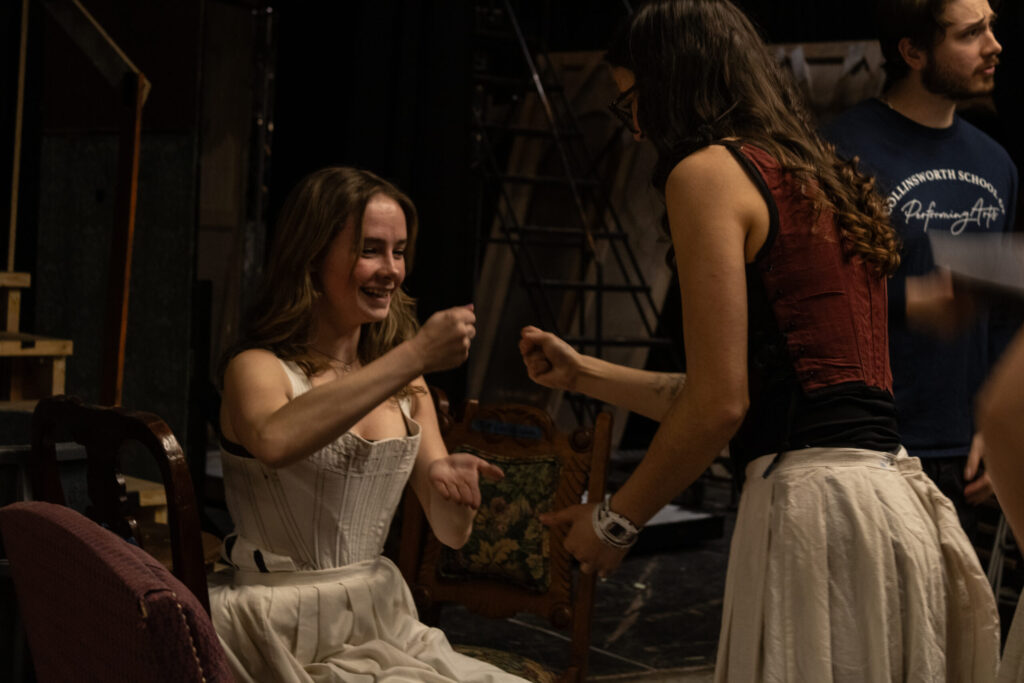
From auditions to callbacks, California Baptist University students navigated the lengthy process of becoming actors in training.
Auditions took place on the Wallace Theatre stage in front of a panel of directors. Students performed a song and a monologue similar to the show. Ava Hill, sophomore theatre major, said she prepared by reading and watching the show so she could tailor her audition to a character that fit her type.
“I take a look at the shows my pieces are from to make sure I understand the characters’ motivations,” Hill said.
For the song, Hill chose a style similar to the show and analyzed the melody.
Casting roles was not a singular process; it involved collaboration between the division director and the semester directors. Depending on the show, other team members such as vocal instructors, choreographers and music directors also provided input.
Zachary Bortot, associate professor and division director of theatre arts, discussed the casting process.
“We discuss what best serves the story, what creates the strongest ensemble and what supports the program’s educational mission,” Bortot said.
Preparation and talent were foundational when auditioning, but directors also considered a student’s growth trajectory, chemistry among actors, the physical or vocal demands of a role and how each performer fit into the flow of the production.
“Casting is not simply about identifying the most talented individual in a vacuum. It is about building a cohesive company,” Bortot said.
Directors also considered the long-term development of performers over four years, placing students in roles that would help them grow rather than roles that simply felt like an obvious fit.
Callbacks allowed directors to gather more information about performers. Not everyone was called back for the same reason. Directors often evaluated several actors for a role, assessed chemistry between performers and considered versatility. Receiving a callback did not guarantee casting, and not receiving one did not mean an actor was out of consideration.
Directors selected performers for callbacks based on preparation, production needs and the ensemble the directors were building.
When students did not receive a role, they were encouraged to view the audition as a learning experience, seek feedback and audition again.
“The students who grow the most are often the ones who navigate disappointment with maturity and resilience,” Bortot said.
Bortot said that when actors felt nervous, they should remember the casting team wanted them to succeed. Some performers might or might not fit a director’s vision.
“Professional actors audition constantly and book rarely. Learning how to handle that reality with integrity is part of the training,” Bortot said.
After casting decisions were finalized, the team sent an email with the cast list and rehearsals began the day after callbacks. Directors divided rehearsal time among different tasks to make the most of participants’ schedules.
Rehearsals ran Monday through Saturday from 6:30 p.m. to 10:30 p.m. As the show approached, tech week rehearsals ran from 5 p.m. to midnight. All actors attended these rehearsals as the cast completed full runs of the show in makeup, hair and costume.
Many offstage roles were also vital to a production. Students worked backstage, in lighting and sound, as stage managers and in hair and makeup. Breanna Masters, junior theatre major, described what it was like to be part of a production.
“Theatrical productions are a perfect example of ‘it takes a village.’ Every role is important on stage or off,” Masters said.
Hill said being part of the theatre arts division helped her develop skills in acting and leadership communication.
“We study the great acting teachers and learn all sorts of different methods. We learn how [to] utilize our body, our voice, our breath and our emotions to ‘live truthfully’ in our acting,” Hill said.
Theatre professors also influenced students’ growth as actors.
“I couldn’t be more grateful for this program and for the professors that we have the pleasure of working with,” Masters said. “they’re really great at encouraging us, while also giving us constructive feedback that helps us grow.”
Behind the scenes of auditions and callbacks, the process revealed the intentional work that goes into campus productions. CBU Theatre Arts provides opportunities for students to grow professionally and develop their identity as performers. All CBU students, not only theatre majors, are welcome to audition for productions on campus.


