
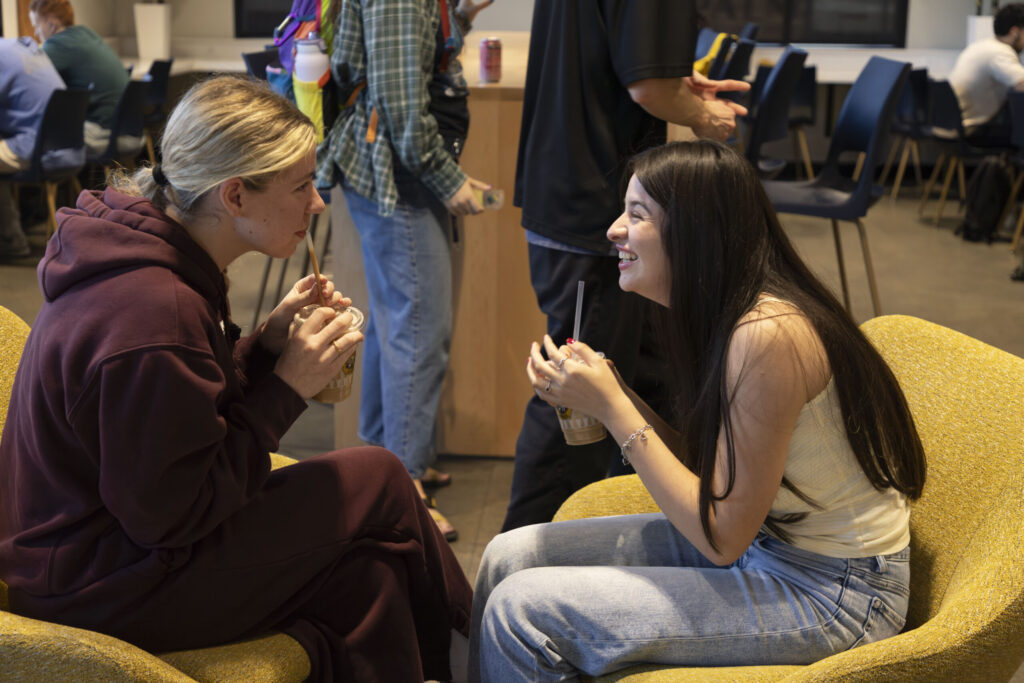
California Baptist University offers opportunities for students to meet over coffee and conversation, which encourages community. Across campus, many spaces allowed students to connect beyond the classroom.
Places such as Wanda’s, The Palm and Lancers Landing gave students opportunities to find common ground and grow friendships over coffee. Unlike going out to dinner, visiting a coffee shop provided a casual, low-pressure setting where students interacted outside their dorms or classes.
Asha Taylor, freshman triple major in political science, history and philosophy, explained coffee shops created a space for face-to-face interaction where people learned life skills through social engagement. She emphasized the importance of a smaller environment in encouraging these experiences.
“Coffee is a way to … slow down and really … take time to just interact,” Taylor said.
Taylor described the benefits of this social environment while balancing a triple major. She said students could strengthen their ability to connect with others in a setting such as a coffee shop, something she found beneficial in her own experience. She also spoke about its impact on being a vessel of Christ and guiding others toward becoming better citizens, friends and church members.
On campus, Taylor preferred Wanda’s and The Palm because the spaces allowed students to study together. Instead of studying alone, students interacted with one another in a low-pressure environment.
Olivia Lee, junior communication studies and Christian Studies double major and barista at her church’s coffee shop, said coffee shops provided a casual environment for spending time with others.
“The environment, whether it’s studying or playing a game together, or generally just spending time, is usually really comfortable for people,” Lee said.
Dr. Julie Goodman-Bowling, professor of anthropology, discussed the importance of social spaces where CBU students connected. She said students shared cultural normalcy and built connections in these environments.
This small group setting allowed culture to act as a “glue to connect” students as they shared ideas and opinions. In coffee shops, people discussed topics they might not express in a classroom.
“By sharing in these experiences, like a cup of coffee together, [it] is an opportunity to communicate about your thoughts and feelings and ideas and purpose,” Goodman-Bowling said.
Coffee shops have also grown in church settings, where congregations of all ages connected before or after services. The ability to gather regularly helped strengthen relationships within the congregation.
Lee said sharing coffee with others created uplifting connections.
“There’s a community developed with consistency,” Lee said.
Lee said God created humanity for interpersonal relationships. She said this connection, hard-wired into people, appeared in a unique way over something as simple as a latte. Coffee shops created space for interaction between people who saw each other weekly at church and those meeting for the first time on campus.
People are created for community, and coffee shops served as a significant place for these relationships to form. As a professor, Goodman-Bowling encouraged students to step outside their comfort zones and invite others into this form of community.
“Go and invite somebody to coffee,” Goodman-Bowling said, “In a way that you might never expect that something could come of that, a better understanding of your professor, your friend or relationship.”
Coffee shops may not have been the busiest or most elaborate places for CBU students to connect, but they offered an intimate and convenient space for interaction. The coffee cup may be small, but its impact when shared with friends, a professor or somebody new may have been greater than expected.

